
I Thought Mind Maps Were Chaos. I Was Wrong.
When I became a pastor in 2004, I had a conviction that God wanted me to write my message notes by hand.
That was strange for me. I've always been a tech guy, and I had taught many times from notes I typed in Word. But the conviction was clear, so I bought half-page notepads with perforated edges, the kind where the pages pull out cleanly, and I started writing.
It was good for me. Writing by hand helped me develop some disciplines and gave me experience I still lean on. It also taught me something I didn't expect: color matters. When I added color to the page, I understood my own notes better. I could glance down and know not only what came next, but how to present it.
After a couple of years I felt the freedom to go back to Word. The colors came with me.
"A Big Jumble of Unorganized Chaos"
Around that time I started hearing about people who used mind maps for their notes. I thought it was crazy. Every mind map I had seen looked like a big jumble of unorganized chaos, with bubbles and lines going in every direction. How could anyone preach from that?
The idea stuck in my head anyway. Eventually I had to try it for myself, if for no other reason than to prove it wasn't right for me.
I was wrong.
I downloaded a free mind-mapping app (I honestly don't remember which one) and started experimenting. Along the way I found it could export a map to a Word document as an outline. I never preached from that export. I didn't need to. Seeing a map turned into an outline one time was enough. Suddenly I could see the logic. What looked like chaos was an outline all along: a main idea, points branching out from it, and everything that supports each point branching out from that. It was the same structure I had always used, laid out so I could see all of it at once.
I taught one message from that free app and knew I needed to switch completely. In 2013 I found iThoughts and bought it right away. Of everything I tried, its maps looked by far the best, and for someone who reads his notes by color and shape, that mattered.
The Colors
The logical structure of a mind map, combined with the color coding I had learned on those notepads, changed my relationship with my preaching notes.
My colors don't carry any special meaning. Nobody handed me a system. They grew out of years of use, one color at a time, as I needed them:
- Orange is for my points. This was the first color, and points have always been orange.
- Red is for application, the places where I turn to the people in front of me and say, "This is for you." Over time it split in two. Dark red marks the application I need to drive home, the most direct or most important challenge in the message. Lighter red marks the gentler ones.
- Blue is for Scripture. Dark blue is the main passage I'm teaching. Light blue is supporting verses and cross-references.
- Green is for other voices. Dark green is direct quotations. Light green is illustrations and examples.
You may want to start with one color, like I did. Give your points a color and preach that way for a while. Add another color when you notice you need one. Trying to learn a whole system at once can be too much. Let yours grow out of your own preaching, the way mine did.
One Map, Start to Finish
Here is a recent message, "Standing Firm in the Faith," from 1 Corinthians 16:13: "Watch, stand fast in the faith, be brave, be strong" (NKJV).

You'll notice it's tall. My maps almost always are, because I keep all the notes on one side. On the iPad I only ever scroll down, never side to side.
The introduction paints two beach pictures. One is slowly drifting: you go into the ocean and look up to find yourself three lifeguard towers down the beach. The other is suddenly shifting: waves coming from different directions, so you have to keep adjusting your stance. Then come the four points, each one orange:
- Stand Firm in the Gospel of Grace
- Stand Firm in the Authority of Scripture
- Stand Firm in the Sovereignty of God
- Stand Firm in the Responsibility of Man
Each point closes the same way, with a short recap of the points so far and those same two dangers, slowly drifting and suddenly shifting. The conclusion brings it home with Ephesians 6 and the armor of God, and the message ends in prayer with 2 Timothy 4: "I have fought the good fight, I have finished the race, I have kept the faith."
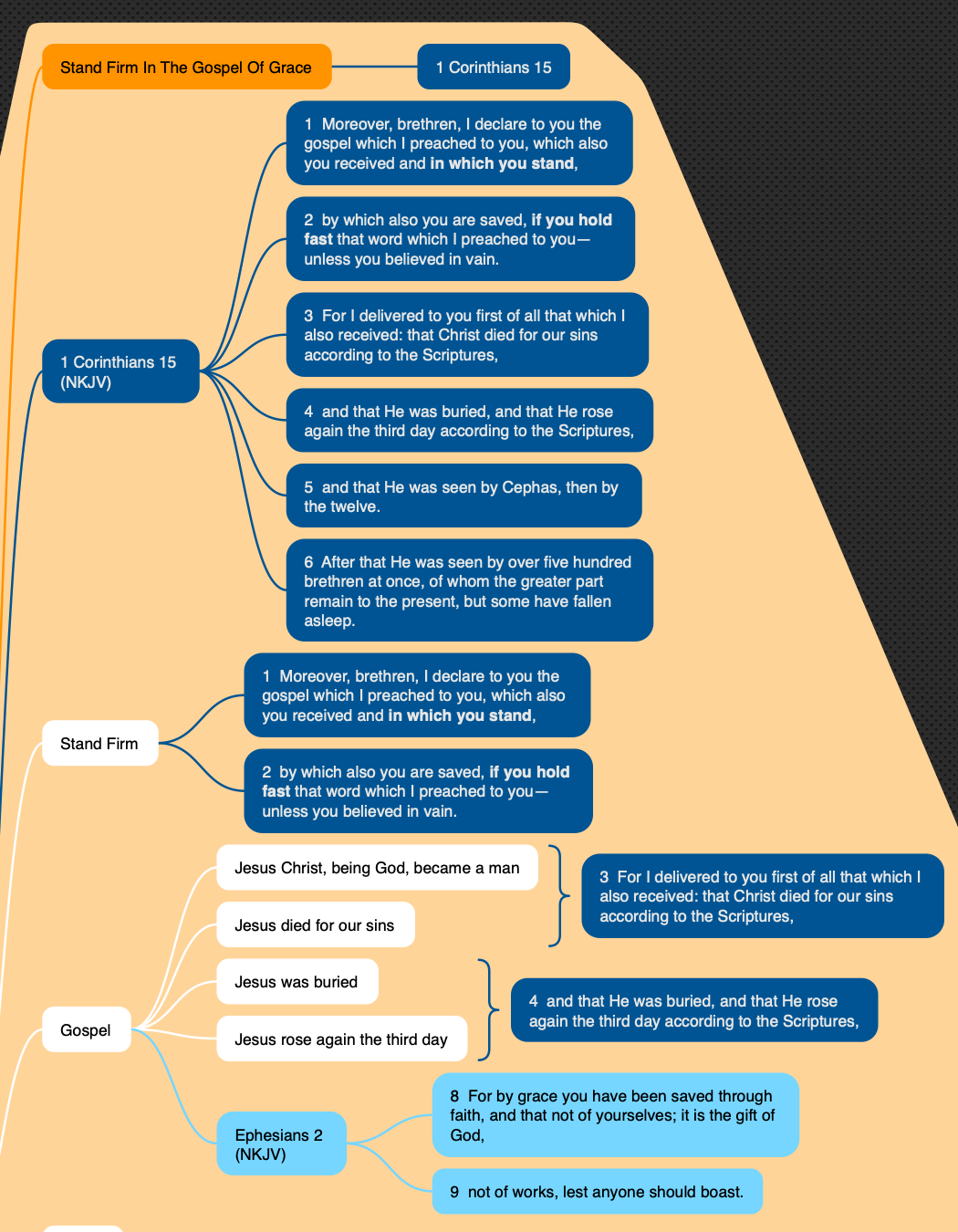
Preaching From the Map
I preach from the map itself, on my iPad. Not an outline, not a printout. The map.
One thing surprised me: the shape of the map helps me as much as the words do. As I work through a point, I can see it coming to its close, and I know a transition is coming before I get there. That makes moving from one point to the next feel natural instead of abrupt.
A Decade of Maps
From 2004 until 2023 I taught at least twice a week. From 2013 on, those messages were mind maps, about 1,000 teaching maps in all.
In 2023 I resigned as pastor. These days I get to teach once or twice a year. When I do, I still build the message as a map, and I still preach it from my iPad.
If It Looks Like Chaos to You
If you have looked at a mind map and thought what I thought, that it's a jumble no one could preach from, I understand. I'd only ask you to try it once, the way I did. Map your next message, then look at it as an outline. If the logic clicks for you the way it did for me, you may find you were wrong too.
Today I make my maps in FerventMind, an app I built so I could mind-map exactly the way I want. That's a story for another post. But this way of preparing doesn't depend on any one app. Any mind-mapping app with colors and an outline view will let you try it.